Overview i-refactory Server
In this section we explain the main capabilities of the i-refactory Server in more details.
i-refactory Server
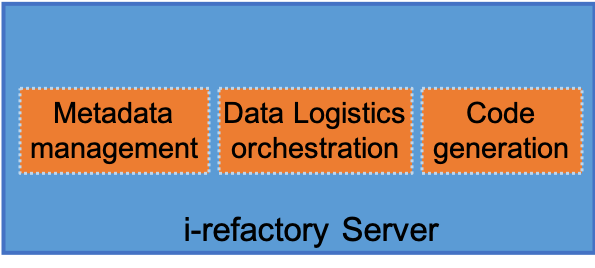
The main capabilities of the i-refactory server are:
- Metadata maintenance
- Data logistics orchestration
- Code generation
Metadata maintenance
Metadata maintenance is best explained through some examples. For an in depth explanation of all the metadata that is managed by the i-refactory server see: i-refactory metadata.
Example 1: Import metadata from the i-refactory modeller
A data modeller has created a new set of data models for a new data supplier. This data supplier will periodically deliver raw data from their internal Order system.
The data modeller has created the typical data models to enable the data transformation from raw data to high quality, integrated and temporal fact data.
In order to be able to use this valuable metadata we need to make it available to our runtime engine. With the use of our Rest API the data modeller requests to update the metadata in the i-refactory runtime metadata repository.
Example 2: Create a delivery
The raw data from the internal Order system is periodically supplied by the Supplier. A request (https Rest API call) to the i-refactory server is made to create a new delivery given the agreement made between the Supplier and Consumer.
Info
You can look at a delivery as being a purchase order in a physical world. In the purchase order you made a specification of the required goods to deliver conform an earlier agreed upon specification of quality, transportation, packaging, ...
Similar to a physical goods delivery, we track and trace the delivered data. We link the metadata of delivery, datalogistics and datamodels and automatically orchestrate and execute the necessary transformation steps, including registering the state of each and every transformation step and each and every data record supplied.
The new delivery is registered in our metadata repository as well. So we now have a purchase order and all other relevant specifications (the metadata from the modeller). The gathered metadata enables our i-refactory server of doing it's work automatically. For example inspecting, validating, ... the supplied raw data. And in the meantime inform you about the progress and state of all the tasks that should be executed.
Info
Our i-refactory metadata repository is, unlike some other metadata tools, fully accessible either through our Rest API or by quering the data access views in the database.
Data Logistics and Code Generation
In a traditional ETL based approach ETL developers receive a functional specification of all the required data transformation steps that should be undertaken. These specifications are translated to an implementation: the typical ETL code and the order in which these tasks should be executed together with their dependencies.
This not only leads to laborious and complex work but also reduces the transparency, testability, changeability, ... of the solution.
The i-refactory uses a different approach. By focusing on metadata you not only have a communicable specification, made in close cooperation with data customers, you now also have the ability to automate a lot of the tedious and error prone manual work.
The i-refactory server automatically takes care of:
- Generating all the required tasks in order to get your data purchase order properly processed to it's desired end state.
- Orchestrating the execution of all these tasks, taking care of dependency management, parallelizing where applicable, managing state, ...
- Generating the appropriate code that is required to execute the required tasks
- Taking care of all the metadata for transparency, auditability, ...
Info
The i-refactory server generates the required transformation code. This generated code is executed in SQL Server. This approach is known as ELT. We believe an ELT approach is preferred over an ETL approach to make use of the strong data processing capabilities of a data engine such as SQL Server.
How does the i-refactory server work
The i-refactory server runs as a Rest API Server on a host machine. You typically make requests to the server over HTTPS and in this request you ask the server to do some work. You could easily integrate our i-refactory service with your custom applications (.Net, Java, Javascript, Python, ...) because of this.
The complete description of our Rest API is available in Swagger format in the browser on your custom configured URL which will be explained in Installing the i-refactory server